A spark arrestor is a metal screen over the top of the flue that stops embers from landing on the roof and blocks birds, squirrels, and raccoons from getting inside. NFPA 211 specifies chimney screening with openings…
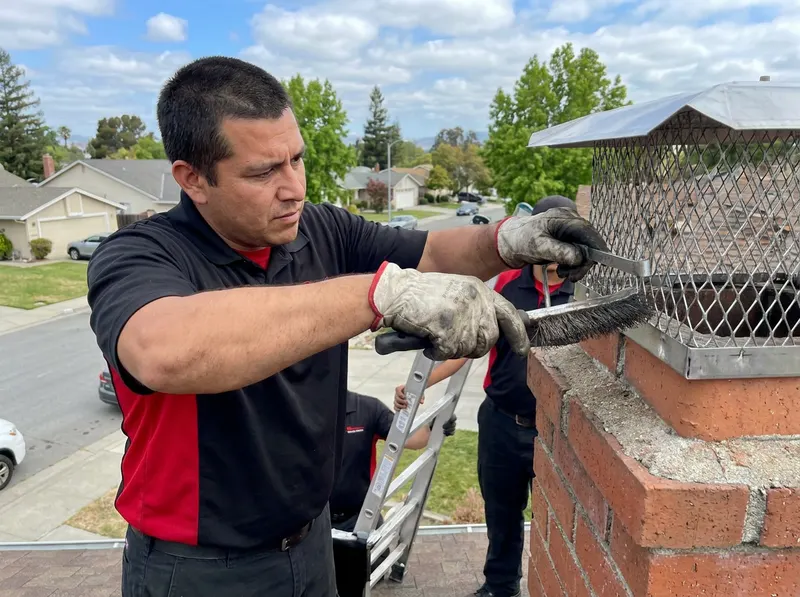
A spark arrestor is a metal screen over the top of the flue that stops embers from landing on the roof and blocks birds, squirrels, and raccoons from getting inside. NFPA 211 specifies chimney screening with openings no smaller than 3/8 inch and no larger than 1/2 inch, small enough to keep the raccoons and nesting birds out, large enough to pass flue gas. A cap that meets that spec doubles as both a spark arrestor and an animal guard, which is why one part solves two problems. Fremont's older housing stock in Niles, Centerville, and Glenmoor often has open clay flues with no cap at all, and those are the ones that fill with nests.
Animal removal starts with a Level 1 inspection using CSIA guidelines: a look down the flue with a light to identify what is inside and whether it is alive, dead, or an abandoned nest. Birds that fall into a flue commonly get stuck on the smoke shelf above the damper; the tech opens the damper and removes the bird, then vacuums the loose twig-and-grass nest material out. To remove the nest fully and clean out the chimney of packed debris, brushing and HEPA vacuuming follow so soot and nesting scraps do not blow back into the living room. Chimney swifts, common near Coyote Hills and Ardenwood, are federally protected during nesting season, so an active swift nest is left until the birds fledge and only the empty nest is removed afterward.
Raccoons are the harder case. A female raccoon treats an open flue in Mission San Jose or Irvington like a den and can drop kits onto the smoke shelf in spring. A cap alone will not evict an animal that is already inside, the animal must leave or be removed by a licensed trapper first, then the 316 stainless mesh spark arrestor is fitted to keep the raccoons out permanently. If it is a single stuck bird choose straightforward removal plus a cap; if there is a live raccoon with young inside, the sequence is wildlife eviction first, cap second.
Most stock caps use galvanized or aluminum mesh that rusts in Fremont's coastal-influenced damp within a few winters. A custom, ideally 316 stainless mesh animal spark arrestor resists corrosion and salt air far longer, and a custom guard is the fit for oversized, multi-flue, or non-standard crowns common on Warm Springs and Cabrillo homes where an off-the-shelf cap does not seal. The trade-off is cost: a universal cap is cheaper up front, while a custom stainless unit costs more but rarely needs replacing. It is reasonable to get some quotes before deciding, a free on-site estimate confirms flue count, crown condition, and the exact cap size.
Every job gets a firm, written price after a free on-site visit.
Tell us about your animal removal & spark arrestor job in Fremont and we'll send a clear, written quote, usually the same day.
 Fluefox Chimney Sweep